
//*image transcription*//
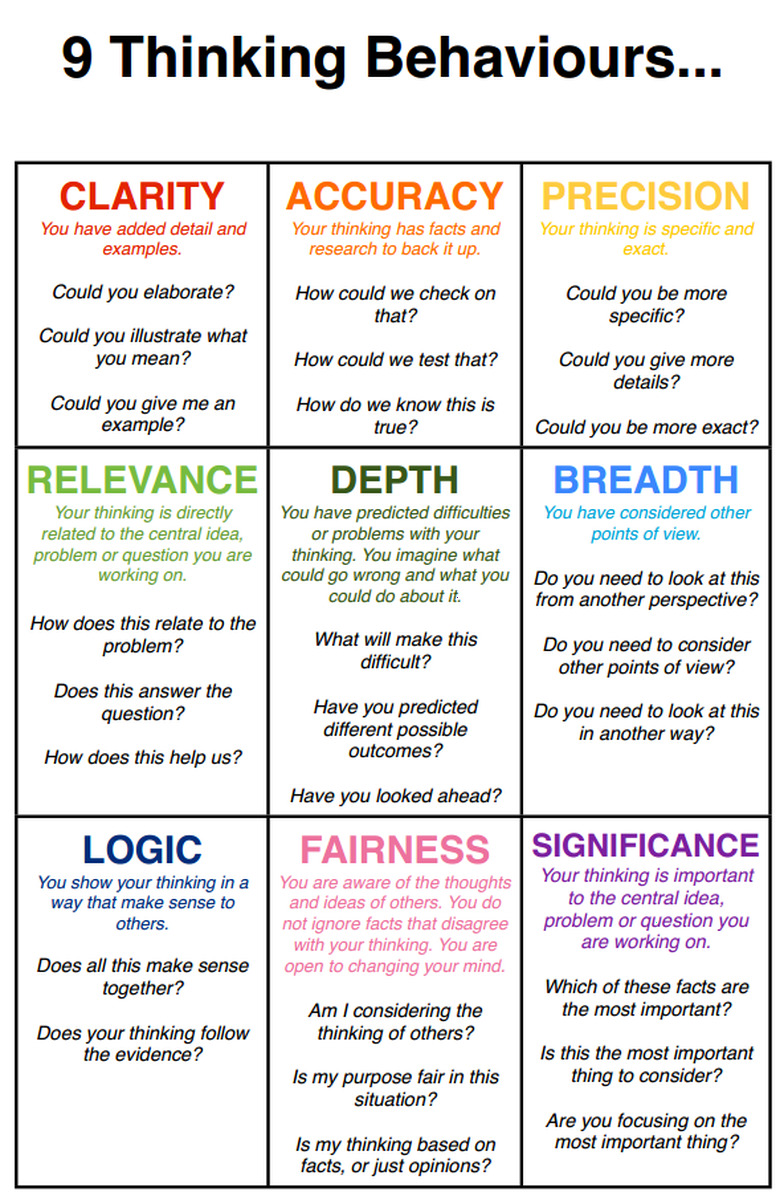
9 Thinking Behaviors
//*9×9 grid left-right, top-bottom*//
Clarity
You have added detail and examples.
Could you elaborate?
Could you illustrate what you mean?
Could you give me an example?
Accuracy
Your thinking has facts and research to back it up.
How could we check that?
How could we test that?
How do we know this is true?
Precision
Your thinking is specific and exact.
Could you be more specific?
Could you give more details?
Could you be more exact?
Relevance
Your thinking is directly related to the central idea, question, problem that you are working on.
How does this relate to the problem?
Does this answer the question?
How does this help us?
Depth
You have predicted difficulties or problems with your thinking. You imagine what could go wrong and what you could do about it.
What will make this difficult?
Have you predicted different possible outcomes?
Have you looked ahead?
Breadth
You have considered other points of view
Do you need to look at this from another perspective?
Do you need to consider other points of view?
Do You need to look at it another way?
Logic
You show [you’re] thinking in a way that makes sense to others.
Does this all makes sense together?
Does your thinking follow the evidence?
Fairness
You are aware of the thoughts and ideas of others. Do not ignore facts that disagree with your thinking. You are open to changing your mind.
Am I considering the thinking of others?
Is my purpose fair in this situation?
Is my thinking based on facts, or just opinion?
Significance
You thinking is important to the central idea problem or question you are working on.
Which of these facts most important?
Is this the most important thing to consider?
Are you focused on the most important thing?


 Dear-Future-AI